Ronald Sauer. North Beach Poet Artist
Written for the occasion of Fanny Renoir's 'A Literary Event' at the Beat Museum/Live Worms Gallery, Thurs. March 16th, 2006
'How is it that that everyone who disappears turns up in San Francisco?" ...Oscar Wilde
Paul Kantner once said, "San Francisco is forty-nine square miles, surrounded by reality." He was right. A number of months ago I left town with some good friends for a sojourn in the Sierras...lots of birds and squirrels to talk to. I said to a deer amid the giant trees, "Wanna hear a poem?" It bounded away, not inelegantly.. no tattooed trust-fund brats pretending to be working class. No dykes with pierced noses and tons of attitude. No commies to insult. What kind of life is that, I asked myself, and high-tailed it back to San Francisco. Funny thing, this reality asides.
Ronald F. Sauer is a native New Yorker and a leading light of the North Beach art and poetry scene, known for trenchant social satires and poignant love poems and for translations of Baudelaire, Aloysius Betrand, and Jacques Prevert. A troubadour of urban America, Sauer is a musician, collagist, art collector, teacher of film history and literature, polymath critic, and compulsive talker. The only formal education he admits to is a summa cum laude in Horizontal Angelology. He likes to spend his free time playing haberdasher to the happily impoverished. He is the co-founder, with artist Rebecca Peters, of Fly-By-Night Productions, which stages art exhibitions, and publishes Off the Cuff Press broadside editions of new poetry and prose.
Two signature events in the S.F. Renaissance have been, first, the elevation of Gregory Corso to the Pope of Dope, from which heights he rain down heroin like manna on the good people of Italy, until they were all happily nodding, "of corso, of Corso...!
cover image - From a painting by Homer Ansley in the collection ofVesuvio
The other was the advent of Jack Hirschman, who exiled from the Bronx vis-a-vis his left-handed critiques and baseball bolshevism, his rank and file refusal to pitch to the Yankee dollar. So like Whitman and Hart Crane, he made West into the American Heartland, where he couldn't resist a season en route with, you guessed it, the Red Socks, distinguishing himself there way out in left field where all during his brief but fleet-footed career he never missed a single vodka highball... T hence he continued onward eventually winding up in S.F. where in the grip of revolutionary determinism, the rosy color high in his cheekbones, de declared, "Some schmoogadoo, and some schmoogadon't!"
The S .F. Renaissance was underway, made up of a growing diversity of folk that is our breath and glory... I would say something at this point about Bret Harte, Mark Twain, Ambroise Bierce, and Jack London, or fast-forward to the charmed irony in Ferlinghetti"s poems or the leonine ferocity of Lamantia's, (and we dare not mention Egypt here or else we'll be adrift on the Nile until dawn), but shall desist, lest something obvious intrude on the fine flow of life's predictable obfuscations...
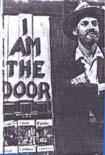
It really kicks in with Allen Ginsberg's Howl and Lawrence Ferlinghetti's courage to publish it, setting off a train of events that , with Henry Miller's publication of the Tropic of Cancer is NYC within the same year, would lay low a good part of the censorship wall that took root in McCarthyism, ushering in new freedoms we can scarce take for granted anymore. Art galleries in North Beach and Kenneth Rexroth's translations from the Chinese and Japanese (and others) struck a high note of internationalism from the very beginning, and this spirit of inquiry and open-mindedness is our enduring legacy. And it is this dialectic of open-mindedness and a diverse community to come home to that makes us so special. The rest of America has community, but it's rather of the "praise the lord and pass the ammunition1" sort, whereas here it's "praise the moment and pass the joint!"
The idea of rebirth is founded on this diversity, this open-mindedness, sexual diversity, and intellectual freedom. The imperial post-WW11 paranoia closed down the American mind for a season or so. Ferlinghetti, Ginsberg and Henry Miller opened it up again.
There's a book dedicated to Henry Miller, written by famous writers to remember him in Paris and elsewhere before they were all famous, called The Happy Rock, and it is dedicated, and I quote, "To freedom of the press, should there ever be any." Freedom of mind and spirit is the cornerstone of San Francisco's greatness. They cannot stop us from reading and thinking. We're the most literate place in America, if not the whole world, and certainly in terms of small presses...We go out into the world, to India, to Morocco, to Amsterdam and the rest of the Europe, and we come back with the enlargement of it and feed the fires of intellectual freedom here at home. Nobody, not academia, not corporate America, not the pseudo two-party system soaked in blood money, can tell us how or what to think. And ours is a translucently literary mind. When I first arrived in S.F. from NTC in the spring of 1971, I was steeped in the Louise Varese New Directions translation of Arthur Rimbaud's A Season of Hell. I was up to my ears in it, and I was actually on the verge of having completely memorized the entire poem of some fifty pages, when, one day, I wandered into the Cafe Trieste, never having heard of it, nor of Bob Kaufman, for that matter, who was standing not far from the counter where I was in line for a coffee. And he looks at me, walks up to me, grabs me by the arms and pulls me gently away from the counter and proceeds to swing me around twice, all the while peering into the depths of my eyes, reading my mind, and yells out, "Rimbaud! Rimbaud!!!" I was flabbergasted. Had I fallen down the rabbit-hole? I had to wonder. But there no mistaking the fact that this stranger. who turned out to be great poet Bob Kaufman, was actually capable of reading me mind!
Nobody tells San Franciscans what to think. But its a fragile situation in some respects, because corporate America has money to burn, and the corporate/yuppie dot-com boom a decade ago was a nightmare. You give a Frenchman a million dollars and he invests it in a library, a wine cellar and the leisure time to think and reflect. You give the same amount of money to corporate Americans and don the viciousness of medieval barons, lusting to scream down at waitresses, blow cigar smoke in your face or nearly run you over at across walk with their moronic SUV's. We survived them, we're back strong, thanks to ourselves and the likes of Matt Gonzalez, Aaron Peskin and Nancy Shanahan, whose vigilance and integrity run parallel, like a double rainbow, to our poetry and art...
I remember one Halloween, some twelve or fifteen years ago, I was feeling lonely and up in the air and didn't know what I wanted to do, if I even had the energy to go out on such a festive occasion. Then I read in the newspaper that some Jesus Freak was here from Texas, a giant newt of a man, by the name of Larry Lea, as bland and sincere as an undertaker, had had the temerity to rent the old Brooks Hall on Grove and Larkin streets and had actually come to preach to us heathens the falseness of this last great holiday. Well, I just couldn't believe it. I went home and forgot my depression, put on some eye shadow and lipstick, dropped a half hit of acid and headed on down there, my synapses singing and determined to give the twit a piece of my mind, even it i had to it myself. I didn't.. There were some two hundred others of like persuasion, a platoon of cops in attendance to keep us separated from them and for the next two hours until they locked themselves in, we jeered and heckled the prissy twits, who had no idea what they had gotten themselves into with their temerity. Leading us on was this terrific dyke or either Jewish or Italian extraction, with a bull horn, who led us into various hilarious chants against their asinine pieties, as they looked on google-eyed at what they had wrought. This woman was a real fearless professional revolutionary who knew just what she was doing. Among the many chants we heaved at them were "Larry Lea fives bad head, Larry lea gives bad head!" But my favorite was , and it recurred, rose to many occasions where it never failed to get the juices going with something of that old Roman know-how: "Bring back the lions! Bring back the lions!"--It was delightful, my depression was gone and I was elated. The cops had to admit that we had given them the right proper money's worth. When finally the Jesus Freaks had shut themselves in, some seven or eight of the motorcycle detail gave us an escort, left past the illuminated Davies Hall down to the Castro.
When Rebecca Peters moved to North Beach three years ago, and into the Hotel Liguria, she was already a film maven, and a world traveler. And she's been itching for an artistic dimension all her own, itching for it like Gregory a nice fix. But it wasn't until North Beach that it found the right fertile encouragement. Et voila! Within a year she was a full-fledged, gaining encouragement and recognition, creating masterpieces. There is something about this place that makes way for poetry, art, music and freedom. And this thing is community, both strong and fragile simultaneously. It's the kind of thing corporate America would like to kill, if only unconsciously, because it knows it can't sell to us. We don't need them. We're a do-it-ouselves kind of place, or as Jack Hirschman observed in the late eighties, I believe, "North Beach is a 'Ciao' with a neighborhood around it.© Ronald F. Sauer, March 15th, 2006
Corporate America's pseudo-nationalism would have us believe we're all separate, even as the slime of its fluid international capital goes everywhere anonymously to sell out the working man here while setting up child-labor sweatshops there. The biggest bond in U.S. History was engineered to create the national highway system in America, not just to move around tanks and intercontinental ballistic missiles launchable for moving flatbed trucks, but also to destroy the radical working class unionism taking root in the port cities of America. The message was, "go forth ye puritans, ye protestant work-ethic dweebs, go forth fearfully into the god-forsaken suburbs, ye wasps and honkies, be afraid of Afro-Americans, Jews and Catholics. Close your minds and hide in community-less wonderbread 'burbs, where, in your convenient isolation we've arranged for you to have nothing but a television to talk to, and so be safe, be of good cheer--or is that Blue Cheer--and just leave it to Beaver"-- And of course on day they would have to wake up and face the un-music of it all, for there is no there there, no community. And their brighter children, a generation or so later, would be coming back with a vengeance, corporate money lining their pockets, and quite well at ease to displace us and make room for themselves...
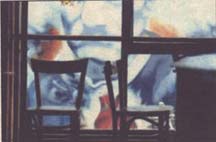
image:Charles Baudelaire looking into Vesuvio from the now defunct City Lights mural across the alley. from Vesuvio's
The Italian Renaissance was also based on diversity, mingled with a longed-for tradition. Jews from Spain who for various reasons were still interconnected with the trade routes of the Arab world, and who still spoke Arabic and Aramaic as well as various European and Mediterranean languages, were paid by Catholic Italian princes to go find the classic literatures of Greece and Rome that had been lost to Europe during the dark ages ...These writings had permeated the high Arab culture of the 7th and 8th centuries and still existed there. Jews found these books and retranslated them back to their original Greek and Latin, for the libraries of said curious Italian Princes of the Renaissance-.-In other words, no Jews , no Arabs, no Renaissance.
Schopenhauer, that wonderfully justified pessimist, was as disburdened of a false faith as was possible. Nevertheless, he was fascinated by such things as the story he chanced to read in a newspaper, concerning a young man in despair who was about to leap to his death in a great cleft in the mountains of the Alps just as a person on a bicycle was gliding by and who, without thinking about it, slides from his bike and intercepts, at mortal danger to himself, the young man about to jump. Schopenhauer says that at such moments the artificial boundaries that define our lives and limits disappear. The bicyclist was the young man, they were one another, and the saving was of both lives. We're all in this together. And that's the last thing corporate America wants us to realize. Too bad the ruling class is so greedy. For they know all too well what they're doing. But we know even better what we're about undoing... Ronald Sauer
memoriam Tony Vaughan by Ronald Sauer
Back to San Francisco Art and Poetry Events |
Poet, Artist, Musician, Translator, Polymath, Art critic, Art promoter & self-described 'Haberdasher to the blithely impoverished', Ronald wrote the autobiographical poem attached below, titled "Self-Portrait with Jaunty Halo That's Really a White-Washed Sphincter", in 2005. I illustrate here with a 2009 collage of his (titled “Self-Portrait with Cocoon Motif Immersed in Worldliness and Crowned by Pretentious Ideals”) ...Now for the poem, read on....
* * * * *
Self-Portrait with Jaunty Halo,
That's Really a White-Washed Sphincter
"Any club that would have me as a member
I'd be too proud to join."
--Groucho Marx
Sarcastic, incisive, rebellious;
Pre-conditional and at times a real punk;
My own worst enemy and dog's best man;
Preternatural but post-industrious;
Translator of great Frogs; a gypsy scholar,
And a cunning linguist; over-educated and
And under the covers; priggish, priapic,
And an assaholic; a rat-rhyming iambist, now
And again; prideful, fixated; and a dipsomaniac;
Stumbling drunk and a barrel of ha-ha’s;
Watched over by angels, undermined by demons;
Wide-eyed and blinded by dubious lights;
Lustful, irascible, and overly generous;
Short on restraint and given to extremes;
Heartfelt about hard-ons and timid toward truth;
Impractical, spendthrift and missing the real point;
A lover of animals and dogged by lovers;
Antsy, irresponsible and afraid to sit still;
Uppity, forceful, and a wind to be reckoned with;
Bullish to wave my own flag of obsessions;
Prehensile in monkey-business, if not post-modern
In flummery; an aficionado of insomniac starlight;
Haughty, naughty, and nodding in; cavalier
On the horsefly of my flighty convictions;
Haberdasher to the blithely impoverished;
A piddler with preciousness; a diddler with death;
Well-read, and, well, why?
Fully matriculated in the school of hard knocks;
Passionate, pugilistic, and impertinent;
Pre-Socratic when not post-traumatic
And professorial if not full to flatulence;
A jumper-in; hell-bent on feelings;
A free-rider upon Bacchus and his pards;
Arrested in development if not in temerity;
A first lieutenant under general malaise;
Two-fisted, forewarned, and high-stepping backwards;
A bingo existentialist; honest to a San Andreas;
Underpaid and over-indulged; and human,
All too human.
-- Ronald F. Sauer
Ronald Sauer poetry
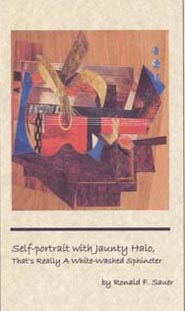
Self-portrait with a jaunty Halo
That's really a white-washed sphineter
cover: collage on wood
© Rebecca Peters, 2001
published Fall 2005 Series #25
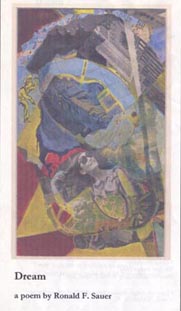
Dream
cover: The River Between Things
cover: Mixed media collage © Ronald Sauer-2004
published 2004
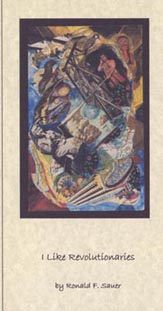
I like Revolutionaries
cover: In Lieu of a Handout, the Devil Calls Women to Industry
dechire' collage with aquarelle ©Ronald Sauer 2004
published Winter, 2006 Series # 29
Ronald Sauer's poetry Series is published by
OFF THE CUFF PRESS © Rebecca Peters
REBECCA
(an acrostic poem by Ronald F. Sauer)
January 19th, 2011
|
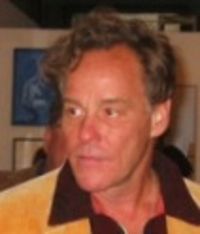 Ronald F. Sauer born February 23, 1950, Midtown Manhattan